Intended Parent Spotlight: For Alan and Brett, a Second Surrogacy Comes With Something the First One Didn’t
Posted by Pathways to Parenthood | April 30, 2026When Brett and Alan tell you about their daughter Dorothea Rose, they light up the way new parents do, and then almost immediately start talking about doing it again.
Dorothea was born last November, and the two Leawood, Kansas dads are still riding the high of it. “Meeting Dorothea and holding her for the first time in the hospital was the most exciting moment of our lives so far,” Brett says. A few weeks later, Alan’s parents made the trip from Kentucky to join Brett’s extended family for Thanksgiving, and Dorothea, just a few weeks old, sat at the center of it. “That was one early moment when we felt really happy and lucky,” Alan says. “There have been lots of happy moments.”
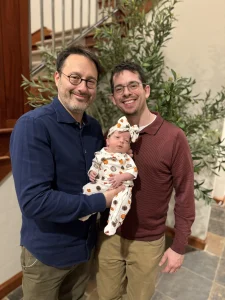
Now they’re preparing to match with a new surrogate and begin their second journey with Pathways to Parenthood, the Kansas based surrogacy agency that guided them through their first. Going in a second time looks different; they know what the process asks of you, what it gives back, and how to show up for it. Their story also happens to answer the questions same-sex couples ask most at the start of their research, about timelines, state law, parental rights, and finding an agency that will actually show up when things get hard.
How Long Does the Surrogacy Process Take for Same-Sex Couples?
Alan and Brett will be the first to tell you: they contacted Pathways To Parenthood before they felt ready. “We had a lot of questions at the time, so we went ahead and contacted Pathways To Parenthood to find out more,” Alan says. “We’re glad we did that because it helped us plan and prepare.”
That instinct serves people well. How long the surrogacy process takes for same-sex couples depends on several factors, and some are specific to same-sex male couples in ways worth understanding early. From initial consultation to birth, a full surrogacy journey typically runs 15 to 24 months. For same-sex male couples, the front end includes steps most heterosexual intended parents skip entirely: selecting an egg donor and creating embryos before surrogate matching can begin. Alan and Brett worked with the University of Kansas Advanced Reproductive Medicine team, and embryo creation was well underway before they were ever matched.
Egg donor selection isn’t a detour. For same-sex male intended parents, it’s where the journey actually starts, and it takes time that’s worth spending well. By the time you sit down with a potential surrogate match, a significant part of your family’s story is already in motion. Going into their second journey, Alan and Brett aren’t starting from zero. They know the rhythm of the process and what the waiting actually feels like. “We’re just excited to go through the process again,” Brett says. “We’re hopeful for the future.”
Does It Matter What State Your Surrogate Lives In?
Yes, and it matters earlier than most couples expect. Where the baby is born determines which state’s laws govern how parentage is established, and for same-sex couples that carries real weight. Some states have clear legal frameworks that protect intended parents’ rights before or at the time of birth. Others are more complicated, and going in without that awareness creates problems that are entirely avoidable.
Pathways to Parenthood works within the Kansas City metro, which means they understand the legal landscape on both sides of the state line and build that knowledge into how they match and coordinate. Both Kansas and Missouri allow gestational surrogacy and have seen favorable legal outcomes for same-sex intended parents, but how parentage is established varies. An experienced agency connects you with attorneys who know both states, so none of that feels like a surprise when your baby arrives.
Alan and Brett’s surrogate location and delivery plan was something Pathways To Parenthood worked through with them during the matching process, not something they had to sort out on their own. “We learned from the outset that she planned to deliver the baby via c-section,” Brett says. “We all kept in good contact throughout the process.”
How Do Same-Sex Couples Establish Parental Rights After Surrogacy?
For same-sex couples, how parental rights are established after surrogacy depends on state law, marital status, and biological connection. The path isn’t universal, but there is a clear process, and it starts well before the birth.
A pre-birth order is a court order obtained during the pregnancy that legally names the intended parents as the child’s parents before the baby is born. Both parents appear on the birth certificate from day one, with no ambiguous window after delivery. Where a pre-birth order isn’t available, second-parent adoption or stepparent adoption can accomplish the same thing. It’s paperwork-heavy but entirely manageable with an experienced legal team and an agency that treats it as a standard part of the process.
For Alan and Brett, the groundwork was done before Dorothea arrived. “We were all together in the hospital when Dorothea was born,” Alan says, noting they also spent time with their surrogate before discharge. “That was a special moment.” Because the legal side was already handled, the day could just be what it was.
How Do Same-Sex Couples Find the Right Surrogacy Agency?
Alan and Brett found Pathways To Parenthood over breakfast. “A good friend and her husband invited us over and offered to answer all our questions,” Brett says. “They suggested we look up Pathways to Parenthood, and that helped us understand much more about the process.” That kind of referral only comes from an agency that has done right by its families.
Finding a surrogate was the hardest part of their first journey. And yet when the time came to begin a second, they went back to the same place. Pathways To Parenthood helped them write the profile letter that introduced them to their surrogate, guided them through matching, and coordinated the legal and medical steps the whole way through. “It has been helpful for us to share with others that we are hoping to grow a family,” Brett says. “Talking with others made us feel more confident and led us to the resources that helped us.”
Dorothea Rose is five months old and thriving. “Our hearts are fuller with love than we ever imagined possible,” Alan says. “We want Dorothea to enjoy her childhood and her family, including her grandparents, cousins, aunts and uncles, and hopefully a sibling or two.” They’re working on the sibling part now. When you’re ready to start your own conversation, Pathways to Parenthood is a good place to begin.
Call Today to Get Started:

When you become a gestational surrogate, you’re helping a family realize their dream of becoming parents.

There are a few basic criteria that must be met to pass medical screening requirements set by fertility clinics.

We offer an honest and transparent breakdown of surrogate compensation packages and coverage of expenses.

Complete our surrogacy application today and get started on your dream of becoming a surrogate.